Tuesday, October 18, 2011

Denali

I have been back in D.C. for nearly a month now and as a result this blog hasn't seen much in the way of updates.  I do have one last update from Alaska though, my trip to Denali. My friend Jim, who I originally met in Ecuador,was up in Alaska working with Fish and Game this past summer.  He entered the Denali road lottery for a chance to drive into Denali national park and was fortunate enough to win a spot.  He invited me to go along and I jumped at the opportunity.
 
A view of Denali as we approached the park.
  (Denali is just visible on the right side of the frame.)

Normally, to see Denali during the summer, you must use the park's bus system to move along the 90 mile dirt road in the park.  However, during a brief 4 day period in September a limited number of private vehicles are allowed to enter the park. Out of 16,000 entrants maybe 1,600 will be given passes for one of the four days.


I flew up to Anchorage, from Homer, to meet Jim and his friends and we got the cars packed and ready to go.  The drive up to Denali from Anchorage takes several hours but the scenery is stunning and the weather was flawless. The clear day afforded us incredible views of the surrounding mountains and we were able to see Denali from nearly a hundred miles away. The leaves were just beginning to turn and the birches and cottonwoods that lined the road glowed golden in the sun.  It was strange driving North at that time of year, as the seasons change, because our six hour drive effected a change of six weeks in the surrounding country.  As we drew closer to the park and gained in latitude and elevation, the trees and shrubs correspondingly lost their leaves.  By the time we'd arrived in the park, most plants were bare.

There are coyotes on the foremost ridge line
if you enlarge the picture and look closely.
Our lottery ticket was good for the second day from six am until midnight.  To take full advantage of our time we booked a spot in a campground at the edge of the park.  It was a fairly cold night, getting down below 30 degrees, but fortunately we all had warm bags.  Like the day before, we had wonderful weather in the park and were able to see the mountain for most of the morning which is fairly unusual.  Many people go to Denali and never get to see the mountain itself due to the climate produced by its sheer size.

Lichen growing in the tundra
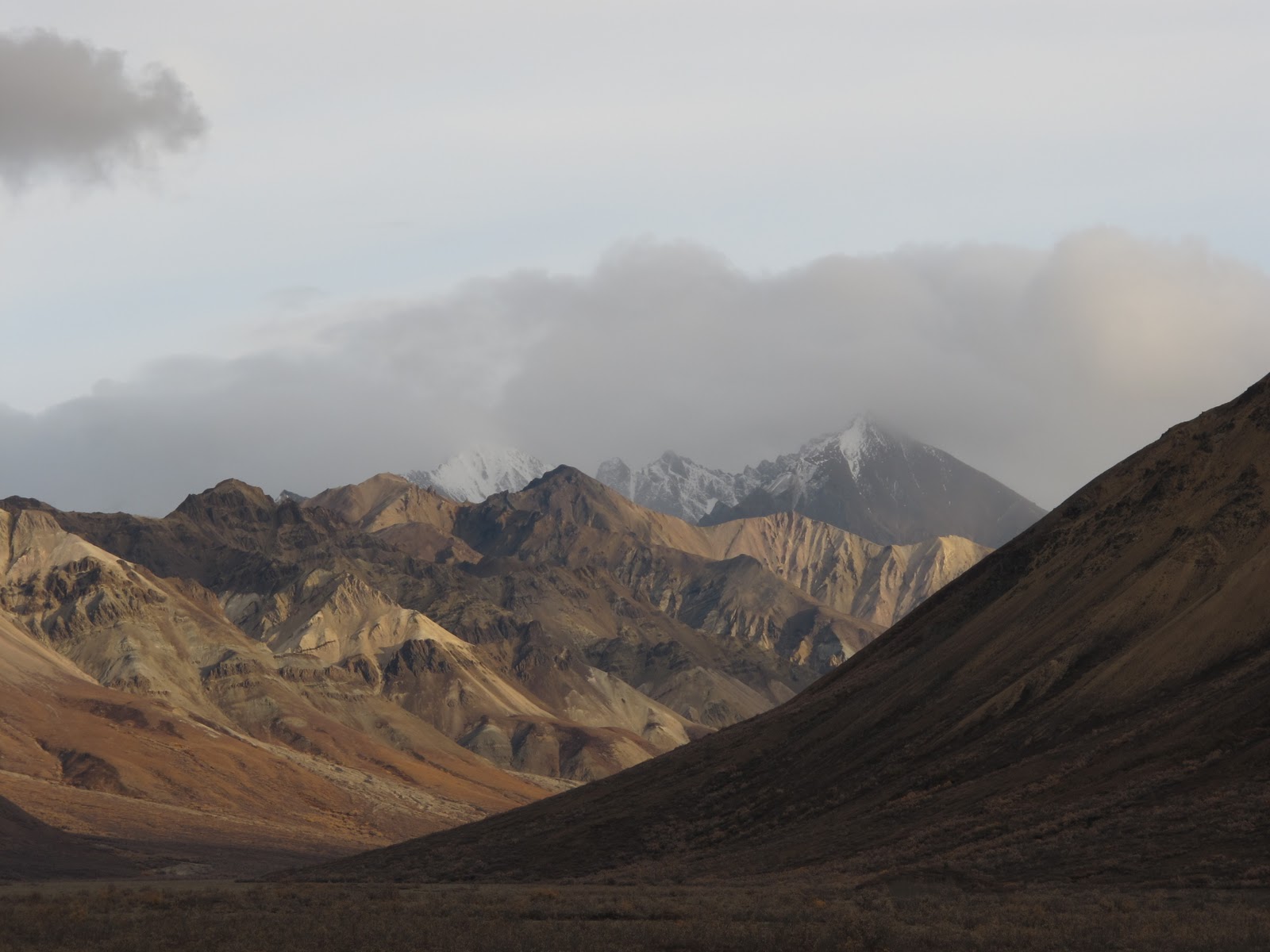
 The terrain in the park itself was not what I'd expected.  The entrance to the park brought us past stands of stunted spruce trees that struggled to grow to their normal size; none of these trees were much more than 30 feet tall.  Once we'd passed through the spruce trees the ground opened up into tundra with tiny lichens growing amongst stunted plants and trees.  A glacially active area, much of the terrain had been carved out during previous ice ages, leaving behind glacial washes and ragged mountains.  The color of this rocky terrain varied greatly with the type of rock and ranged from deep reds to sulfurous yellows and at times felt more like something out of the American South West than interior Alaska.

As we drove down the road it was fairly common to see other cars pulled to the side which was a great indicator that there was something interesting nearby and also made it easy to see wildlife you might otherwise have missed.   Park rangers were often be present at the mass pullovers to make sure people behaved themselves around the animals.  This was especially important when the animals decided to cross the road as it would bring the visitors and animals extremely close together.
That guy in red moved to safety after setting up his camera
directly in front of the moose.

In one instance a Bull Moose decided to cross the road exactly where we were all lined up and watching it.  People stayed close to their cars as the thousand pound animal passed through.  However, one man foolishly set up his camera directly in front of the moose and had to scramble out of the way to avoid being trampled.  Moose are often considered more dangerous than bears because of their lack of intelligence and inclination to panic.  If the moose had so chosen, he could have easily crushed the man instead of skittishly walking around him.

Sow with two cubs
Usually, such events were a little more controlled.  At one point on our way back we encountered a Sow and two cubs that were grazing and slowly moving towards the line of cars parked by the road.  They eventually turned away but the rangers did an excellent job of keeping everyone in their cars (especially the over-eager photographers) when the bears started to get close.

The bear approaching our car
Our closest encounter with wildlife occurred near sunset on our way out of the park.  As we had done several times before, we were pulled over and watching a bear grazing when it became apparent that he was headed directly towards us.  The bear passed within six feet of our open windows and unconcernedly passed behind our car and into the brush on the other side of the road.  Its immense size and powerful frame would have made short work of any car door.  Watching the bear's muscles ripple under its silvery fur was an excellent reminder to respect these animals and the environment in which they live.
The same bear passing behind the car


Thursday, September 22, 2011

Bafflement

Due to some trouble with Lene's flight and mine, I've spent something like 12 hours just waiting in the Anchorage airport today.  Besides getting to spend a little more time together before we part ways, the only perk of spending time in an airport is the fantastic people watching.

I'm sitting across from a family as I write this and they are apparently on the same flight as I am which connects in Houston.  One of the middle aged women in the family mentioned that she hoped they had a wheel chair for her in Houston because she gets so out of breath walking around.  The rest of the family then showed up with bags of McDonalds for everyone.  People can be amazing sometimes.

Edit: I went to McDonalds right after that.

Wednesday, September 7, 2011

Creature feature: Opalescent Nudibranch

One of the more beautiful creatures we find in our tidepools is the Opalescent Nudibranch or Hermissenda Crassicornis.  This organism has several adaptations (some of which I mentioned in an earlier post on Mollusks) that make it particularly interesting.  Most impressive is the nudibranch's ability to 'steal' stinging cells from its prey and pass them untriggered to the tips of its cerrata (the orange tipped structures on its back).    

Click to enlarge

As they live less than a year, they must go through their life cycle quickly and seem to do so without respect for the seasons.  Being hermaphrodites, nudibranchs can self-fertilize or mate with any other nudibranch of the same species though they usually choose the latter option (presumably to ensure the diversity of their gene pool).  

Another species, the Barnacle-eating Nudibranch, seen out of water
When tide-pooling, we often find opalescent nudibranchs close to the water line tucked away in rock crevices or sticking to pieces of kelp.  Searching amongst hydroids, one of their main food sources, is another way to increase the chances of an encounter with this nudibranch.  If you do find a sea slug and it is out of water, it is nice to have a small specimen jar or large clam shell that you can fill so as to observe the nudibranch in all its glory.  Be careful though, nudibranchs are delicate animals and cannot withstand rough handling.

Sources:
Monterey bay aquarium
Puget Sound Sealife

Monday, August 15, 2011

The Pebble Mine

The Pebble Mine is a proposed project by a multi-national conglomerate that wants to mine gold and copper from the head of Bristol Bay, Alaska.  If built, the Pebble Mine would be the largest open pit mine in North America and would leave behind a mile-wide hole along with tons of toxic waste.  This is bad enough, but the placement of the mine is even worse.  They want to put this mine at the headwaters of the two richest Sockeye Salmon runs in the world.

The mine will be exhausted in fifty years leaving behind toxic waste that, if not contained properly, could easily destroy not only the salmon runs but many other species (such as Beluga whales) that live in the nearby Cook Inlet.  To compound the ridiculousness of this proposed mine, the mine site is not only in the midst of an extraordinarily rich ecosystem, it is also in an extremely seismically active region (the Pacific Rim of Fire) so any containment of the planned toxic wastes would almost certainly be temporary in nature.

If you enjoy eating good wild salmon or just care about the often unnecessary destruction of our natural world please go to this website, learn more about the Pebble Mine and write a letter condemning the mine.

Tuesday, August 9, 2011

The brown bears of Hallo bay in Katmai national park

"OK, we're going to just follow this sow and cub for a while and see if they start nursing."
And so the ten of us began following the two brown bears through the tall grass trying to get a better view and hoping to see a cub nursing from it's mother.  It went against nearly everything I'd learned about bears.  But this is what we'd come to do in Hallo bay of Katmai national park: to see bears.  We were extremely close, so close that my camera's paltry 5x zoom was more than enough to grab some good shots.  At one point during our pursuit we lost sight of the cub only to have it raise up behind a stream bank not 15 feet away from us.  You can't appreciate the size of these animals until they get up close.  Our guides estimated the cub at 250-300lbs, substantially larger than anyone in our group.  A female brown bear might get up to 900 lbs and an adult male to 1200lbs or more.  


Because the bears at Katmai have such an abundance of food and had not been hunted or fed or had any poor interactions with people they ignored us completely.  Occasionally a small cub would look up at us but none of the older bears paid us any heed.  To keep safe we were told to always stay within arms reach of someone else and not to make any sudden or loud movements.  We were told that as long as we walked around calmly in a group we would experience no problems with the bears.  


When we'd spent enough time with one group of bears there were always more around that we could walk over to and observe.  The bears are particularly fond of Hallo bay because it provides areas to fish, clam and forage and we witnessed bears getting food by all of these methods.  Despite the good fishing and clamming in the area, a large portion of a bear's diet comes from vegetation.  It was strange watching such a large predator munching away contededly on the grasses in the area.


I was fortunate enough to go on this amazing trip thanks to my parents who came up from Washington D.C. to visit this week.  All it all it was an awe inspiring experience and I would highly recommend it and Kbay air (the company we went with) to anyone looking to do some bear viewing.  I'll just let a few of my pictures do the rest of the talking. 


Oh, and the views from the plane were spectacular too:


Wednesday, July 27, 2011

Eagles!

One of the cool things about Homer (and Alaska in general) is the number of Bald Eagles living here.  They are everywhere.  The first time I came to Homer in 2008 there was a woman dubbed "the eagle lady" who fed the eagles near the harbor.  As a result you would see them by the dozen sitting on pilings, along rock walls and on the tops of shops and homes.  She died later that year and there was legitimate concern as to what the eagles would do when deprived of one of their major food sources.  People with small dogs had to be particularly careful as eagles have been known to target them.  In the end they decided to continue feeding the Eagles through the winter and then slowly wean them off the unnatural food source.


Now, a few years removed from "the eagle lady", the eagles are still plentiful but are not as concentrated around the harbor.  Our country has perpetrated a few myths about eagles, portraying them as hunters descending on their prey with a mighty screech. While eagles do hunt for their food, consuming fish, birds or small mammals, they are also scavengers.  The best place in Homer to get photos of Bald Eagles is at the dump.  Eagles, along with the Glaucous winged gulls, are drawn to trash, dead animals and other easy meals.


As for the "mighty screech" that you often hear on TV, whoever first put eagles on film decided that the eagle's actual call was too wimpy to be associated with America's mascot.  Instead they dubbed in the voice of the Red Tailed Hawk which provides that classic screech. Here is a video of a Red Tailed Hawk's call, and here is a Bald Eagle's call.  The eagle's call is quite beautiful but it is not what you would expect from such a large, powerful bird.


Interestingly, the juvenile eagles often appear larger than the adults.  This is due to the juvenile's feathers which are longer and heavier than those on an adult eagle.  The juvenile feathers serve as "training wheels" while young eagles are learning to fly.  The adult's smaller feathers allow them to fly more gracefully and with greater maneuverability than the younger eagles.

Juvenile Eagle between two adults

Despite the cynical attitude I've treated eagles with in this post, I still stop an admire them when they soar past.  They add to the majesty of this place and it is a privilege to be able to see them with such frequency.


Friday, July 22, 2011

Layers of complexity


This photo was taken near Kasitsna bay, where we occasionally run programs.  At first glance the subject of the photo appears to be a striped hermit crab.  The picture itself isn't bad, the colors turned out well and the lighting is nice, but if you look again at the hermit crab you might start to notice some things.
Click for full size
  First of all, the shell that the hermit crab is using is red.  This is because the hermit crab is living inside a wandering sponge.  There are some species of sea sponge that will attach themselves to snail shells and slowly consume the shell until nothing is left but the sponge. Once the snail is dead it is not uncommon for a hermit crab to move in and allow the sponge to continue its wanderings.  

Not many things eat sponges; they are full of sharp spicules that can wreak havoc on a creature's digestive tract.  In an earlier post I covered mollusks and talked a little bit about Nudibranchs, which often eat organisms that nothing else will.  The yellow blob you see sitting on top of the hermit crab is actually a False Lemon Peel Nudibranch that specializes in eating sponges.  

To recap, a wandering sponge began growing on a snail shell which was then inhabited by a hermit crab.  The sponge attracted a nudibranch which is now eating the hermit crab's home.  If you've been following this blog you should be able to name two of the three phylums represented in this photo.  Athropods are represented by the crab, Mollusca by the Nudibranch and Porifera by the sponge.

Even after three seasons of doing this, I'm still consistently amazed by the things that show up on our beaches.