Showing posts with label Alaska. Show all posts

Tuesday, October 18, 2011

Denali

I have been back in D.C. for nearly a month now and as a result this blog hasn't seen much in the way of updates.  I do have one last update from Alaska though, my trip to Denali. My friend Jim, who I originally met in Ecuador,was up in Alaska working with Fish and Game this past summer.  He entered the Denali road lottery for a chance to drive into Denali national park and was fortunate enough to win a spot.  He invited me to go along and I jumped at the opportunity.
 
A view of Denali as we approached the park.
  (Denali is just visible on the right side of the frame.)

Normally, to see Denali during the summer, you must use the park's bus system to move along the 90 mile dirt road in the park.  However, during a brief 4 day period in September a limited number of private vehicles are allowed to enter the park. Out of 16,000 entrants maybe 1,600 will be given passes for one of the four days.


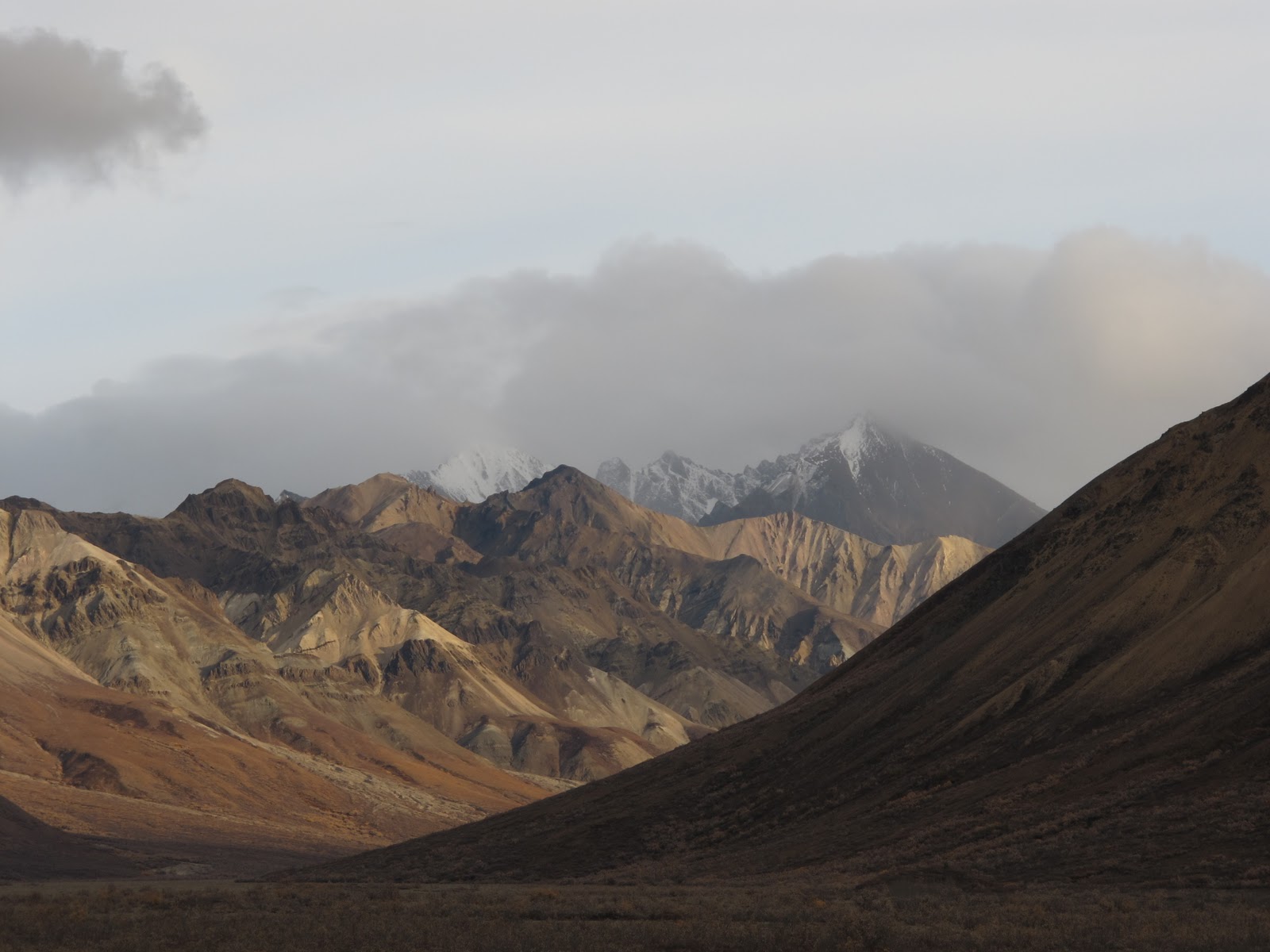
I flew up to Anchorage, from Homer, to meet Jim and his friends and we got the cars packed and ready to go.  The drive up to Denali from Anchorage takes several hours but the scenery is stunning and the weather was flawless. The clear day afforded us incredible views of the surrounding mountains and we were able to see Denali from nearly a hundred miles away. The leaves were just beginning to turn and the birches and cottonwoods that lined the road glowed golden in the sun.  It was strange driving North at that time of year, as the seasons change, because our six hour drive effected a change of six weeks in the surrounding country.  As we drew closer to the park and gained in latitude and elevation, the trees and shrubs correspondingly lost their leaves.  By the time we'd arrived in the park, most plants were bare.

There are coyotes on the foremost ridge line
if you enlarge the picture and look closely.
Our lottery ticket was good for the second day from six am until midnight.  To take full advantage of our time we booked a spot in a campground at the edge of the park.  It was a fairly cold night, getting down below 30 degrees, but fortunately we all had warm bags.  Like the day before, we had wonderful weather in the park and were able to see the mountain for most of the morning which is fairly unusual.  Many people go to Denali and never get to see the mountain itself due to the climate produced by its sheer size.

Lichen growing in the tundra
 The terrain in the park itself was not what I'd expected.  The entrance to the park brought us past stands of stunted spruce trees that struggled to grow to their normal size; none of these trees were much more than 30 feet tall.  Once we'd passed through the spruce trees the ground opened up into tundra with tiny lichens growing amongst stunted plants and trees.  A glacially active area, much of the terrain had been carved out during previous ice ages, leaving behind glacial washes and ragged mountains.  The color of this rocky terrain varied greatly with the type of rock and ranged from deep reds to sulfurous yellows and at times felt more like something out of the American South West than interior Alaska.

As we drove down the road it was fairly common to see other cars pulled to the side which was a great indicator that there was something interesting nearby and also made it easy to see wildlife you might otherwise have missed.   Park rangers were often be present at the mass pullovers to make sure people behaved themselves around the animals.  This was especially important when the animals decided to cross the road as it would bring the visitors and animals extremely close together.
That guy in red moved to safety after setting up his camera
directly in front of the moose.

In one instance a Bull Moose decided to cross the road exactly where we were all lined up and watching it.  People stayed close to their cars as the thousand pound animal passed through.  However, one man foolishly set up his camera directly in front of the moose and had to scramble out of the way to avoid being trampled.  Moose are often considered more dangerous than bears because of their lack of intelligence and inclination to panic.  If the moose had so chosen, he could have easily crushed the man instead of skittishly walking around him.

Sow with two cubs
Usually, such events were a little more controlled.  At one point on our way back we encountered a Sow and two cubs that were grazing and slowly moving towards the line of cars parked by the road.  They eventually turned away but the rangers did an excellent job of keeping everyone in their cars (especially the over-eager photographers) when the bears started to get close.

The bear approaching our car
Our closest encounter with wildlife occurred near sunset on our way out of the park.  As we had done several times before, we were pulled over and watching a bear grazing when it became apparent that he was headed directly towards us.  The bear passed within six feet of our open windows and unconcernedly passed behind our car and into the brush on the other side of the road.  Its immense size and powerful frame would have made short work of any car door.  Watching the bear's muscles ripple under its silvery fur was an excellent reminder to respect these animals and the environment in which they live.
The same bear passing behind the car


Wednesday, September 7, 2011

Creature feature: Opalescent Nudibranch

One of the more beautiful creatures we find in our tidepools is the Opalescent Nudibranch or Hermissenda Crassicornis.  This organism has several adaptations (some of which I mentioned in an earlier post on Mollusks) that make it particularly interesting.  Most impressive is the nudibranch's ability to 'steal' stinging cells from its prey and pass them untriggered to the tips of its cerrata (the orange tipped structures on its back).    

Click to enlarge

As they live less than a year, they must go through their life cycle quickly and seem to do so without respect for the seasons.  Being hermaphrodites, nudibranchs can self-fertilize or mate with any other nudibranch of the same species though they usually choose the latter option (presumably to ensure the diversity of their gene pool).  

Another species, the Barnacle-eating Nudibranch, seen out of water
When tide-pooling, we often find opalescent nudibranchs close to the water line tucked away in rock crevices or sticking to pieces of kelp.  Searching amongst hydroids, one of their main food sources, is another way to increase the chances of an encounter with this nudibranch.  If you do find a sea slug and it is out of water, it is nice to have a small specimen jar or large clam shell that you can fill so as to observe the nudibranch in all its glory.  Be careful though, nudibranchs are delicate animals and cannot withstand rough handling.

Sources:
Monterey bay aquarium
Puget Sound Sealife

Monday, August 15, 2011

The Pebble Mine

The Pebble Mine is a proposed project by a multi-national conglomerate that wants to mine gold and copper from the head of Bristol Bay, Alaska.  If built, the Pebble Mine would be the largest open pit mine in North America and would leave behind a mile-wide hole along with tons of toxic waste.  This is bad enough, but the placement of the mine is even worse.  They want to put this mine at the headwaters of the two richest Sockeye Salmon runs in the world.

The mine will be exhausted in fifty years leaving behind toxic waste that, if not contained properly, could easily destroy not only the salmon runs but many other species (such as Beluga whales) that live in the nearby Cook Inlet.  To compound the ridiculousness of this proposed mine, the mine site is not only in the midst of an extraordinarily rich ecosystem, it is also in an extremely seismically active region (the Pacific Rim of Fire) so any containment of the planned toxic wastes would almost certainly be temporary in nature.

If you enjoy eating good wild salmon or just care about the often unnecessary destruction of our natural world please go to this website, learn more about the Pebble Mine and write a letter condemning the mine.

Tuesday, August 9, 2011

The brown bears of Hallo bay in Katmai national park

"OK, we're going to just follow this sow and cub for a while and see if they start nursing."
And so the ten of us began following the two brown bears through the tall grass trying to get a better view and hoping to see a cub nursing from it's mother.  It went against nearly everything I'd learned about bears.  But this is what we'd come to do in Hallo bay of Katmai national park: to see bears.  We were extremely close, so close that my camera's paltry 5x zoom was more than enough to grab some good shots.  At one point during our pursuit we lost sight of the cub only to have it raise up behind a stream bank not 15 feet away from us.  You can't appreciate the size of these animals until they get up close.  Our guides estimated the cub at 250-300lbs, substantially larger than anyone in our group.  A female brown bear might get up to 900 lbs and an adult male to 1200lbs or more.  


Because the bears at Katmai have such an abundance of food and had not been hunted or fed or had any poor interactions with people they ignored us completely.  Occasionally a small cub would look up at us but none of the older bears paid us any heed.  To keep safe we were told to always stay within arms reach of someone else and not to make any sudden or loud movements.  We were told that as long as we walked around calmly in a group we would experience no problems with the bears.  


When we'd spent enough time with one group of bears there were always more around that we could walk over to and observe.  The bears are particularly fond of Hallo bay because it provides areas to fish, clam and forage and we witnessed bears getting food by all of these methods.  Despite the good fishing and clamming in the area, a large portion of a bear's diet comes from vegetation.  It was strange watching such a large predator munching away contededly on the grasses in the area.


I was fortunate enough to go on this amazing trip thanks to my parents who came up from Washington D.C. to visit this week.  All it all it was an awe inspiring experience and I would highly recommend it and Kbay air (the company we went with) to anyone looking to do some bear viewing.  I'll just let a few of my pictures do the rest of the talking. 


Oh, and the views from the plane were spectacular too:


Wednesday, July 27, 2011

Eagles!

One of the cool things about Homer (and Alaska in general) is the number of Bald Eagles living here.  They are everywhere.  The first time I came to Homer in 2008 there was a woman dubbed "the eagle lady" who fed the eagles near the harbor.  As a result you would see them by the dozen sitting on pilings, along rock walls and on the tops of shops and homes.  She died later that year and there was legitimate concern as to what the eagles would do when deprived of one of their major food sources.  People with small dogs had to be particularly careful as eagles have been known to target them.  In the end they decided to continue feeding the Eagles through the winter and then slowly wean them off the unnatural food source.


Now, a few years removed from "the eagle lady", the eagles are still plentiful but are not as concentrated around the harbor.  Our country has perpetrated a few myths about eagles, portraying them as hunters descending on their prey with a mighty screech. While eagles do hunt for their food, consuming fish, birds or small mammals, they are also scavengers.  The best place in Homer to get photos of Bald Eagles is at the dump.  Eagles, along with the Glaucous winged gulls, are drawn to trash, dead animals and other easy meals.


As for the "mighty screech" that you often hear on TV, whoever first put eagles on film decided that the eagle's actual call was too wimpy to be associated with America's mascot.  Instead they dubbed in the voice of the Red Tailed Hawk which provides that classic screech. Here is a video of a Red Tailed Hawk's call, and here is a Bald Eagle's call.  The eagle's call is quite beautiful but it is not what you would expect from such a large, powerful bird.


Interestingly, the juvenile eagles often appear larger than the adults.  This is due to the juvenile's feathers which are longer and heavier than those on an adult eagle.  The juvenile feathers serve as "training wheels" while young eagles are learning to fly.  The adult's smaller feathers allow them to fly more gracefully and with greater maneuverability than the younger eagles.

Juvenile Eagle between two adults

Despite the cynical attitude I've treated eagles with in this post, I still stop an admire them when they soar past.  They add to the majesty of this place and it is a privilege to be able to see them with such frequency.


Friday, July 22, 2011

Layers of complexity


This photo was taken near Kasitsna bay, where we occasionally run programs.  At first glance the subject of the photo appears to be a striped hermit crab.  The picture itself isn't bad, the colors turned out well and the lighting is nice, but if you look again at the hermit crab you might start to notice some things.
Click for full size
  First of all, the shell that the hermit crab is using is red.  This is because the hermit crab is living inside a wandering sponge.  There are some species of sea sponge that will attach themselves to snail shells and slowly consume the shell until nothing is left but the sponge. Once the snail is dead it is not uncommon for a hermit crab to move in and allow the sponge to continue its wanderings.  

Not many things eat sponges; they are full of sharp spicules that can wreak havoc on a creature's digestive tract.  In an earlier post I covered mollusks and talked a little bit about Nudibranchs, which often eat organisms that nothing else will.  The yellow blob you see sitting on top of the hermit crab is actually a False Lemon Peel Nudibranch that specializes in eating sponges.  

To recap, a wandering sponge began growing on a snail shell which was then inhabited by a hermit crab.  The sponge attracted a nudibranch which is now eating the hermit crab's home.  If you've been following this blog you should be able to name two of the three phylums represented in this photo.  Athropods are represented by the crab, Mollusca by the Nudibranch and Porifera by the sponge.

Even after three seasons of doing this, I'm still consistently amazed by the things that show up on our beaches.


Thursday, July 21, 2011

Fab four Phyla part four: Arthropoda

Arhtropoda is the largest and most diverse phlyum on Earth.  The pre-fix Athro refers to joints (as in arthritis) and pod means foot, so the name arthropod refers to animals with jointed feet or legs. The phylum arthropoda encompasses organisms such as insects, spiders and crustaceans.  Besides having jointed legs, athropods also have segmented bodies and a tough chitinous exoskeleton that they occasionally molt.  On our beaches we see mostly crustaceans; i.e. crab, shrimp and barnacles.
Black Clawed Cancer Crab
Its large claws are used to crush barnacles
Most people don't realize that barnacles are so closely related to crabs and shrimp.  Barnacles begin their life as a plankton and as they grow larger they change through various stages until they become a cyprid.  The cyprid's task is to find a good spot to settle on the sea floor and become a barnacle.  They land head first and begin to create a hard, 6 plated calcium shell around themselves.  To feed, they kick out their feet, which are shaped like tiny fans, and collect their food from the water.  We just recently had a barnacle fall out in our area and now everything is coated in the brittle white shells of young barnacles.  You feel bad crushing so many animals underfoot but our beaches are just so packed with life that it is impossible to do otherwise while tidepooling.

Empty molt of a helmet crab
There are several species of crabs on our beaches, though none of them are popular commercially.  Decorator crabs are my personal favorite.  Decorator crabs do not have large claws to protect themselves with, instead they rely on camouflage.  Using their narrow claws, they hang algae and other things from the tiny hooks on the carapace until the blend seamlessly into their environment.  It is nearly impossible to see a decorator crab unless it is moving.  Taking one out of water, they become spider-like, with long narrow legs and a proportionately small body.

A friend holding a decorator crab
Hermit crabs are another popular arthropod found on our beaches.  We have a few different varieties ranging in color from a drab brown to a brilliant orange.  Hermit crabs appropriate the empty shells of other organisms (usually snails) to give themselves additional protection.  Their body curls to fit into the shells and they have legs specifically adapted to hanging onto the shell.  One of their claws is generally over sized and acts as a shield to cover the entrance to their home.  We keep several large hermit crabs in our touch tanks at the field station and you can often watch them squabbling over new shells.

Helmet crabs mating
  At one point there were several species of crabs in Kachemak bay that were commercially important to Homer.  Tanner crabs, Dungeness crabs and King crabs could all be caught in the bay during the late 70's.  No one is exactly sure why the fisheries collapsed; whether it was due to mismanagement, a fuel spill, or just part of a natural cycle, these species no longer exist in Kachemak bay in harvestable numbers.  The Tanner crab and Dungeness crab populations are slowly recovering and hopefully they will continue to do so.
An Orange Hermit crab from our touch tanks

Sunday, June 26, 2011

Gull Island


Just a short boat ride from the Homer Spit is Gull Island, a rookery for sea birds.  Gull island is home to more than 15,000 birds during the summer months when they come to nest.  There are eight different species that nest on gull island, including puffins, cormorants and murres.  


There are two species of gulls here.  The larger of the two is the Glaucous winged gull and the smaller is the Black Legged Kittiwake whose wingtips are black in addition to their legs.  Though these birds will scatter before an eagle, using their maneuverability they will often harass the predator from above to distract it from its intended prey.


When stirred up by an eagle or raven trying to hunt or steal eggs they will take off, en masse, swirling around in enormous flocks as the air fills with the sound of their keening.  When they squabble amongst themselves on the rocks, bickering over nest space, it sounds eerily like children screaming.


Islands like this form important habitats for nesting sea birds.  They need safe places to raise their young away from terrestrial predators.  Here they only have to contend with Eagles.  On the mainland they would need to worry about bears, coyotes and other smaller mammals like marmots.


The gulls and cormorants prefer to nest on the rock faces.  They glue bits of grass to the rock with their own feces which gives gull island a rather pungent smell.  Other species nest on different parts of the rock.  Common murres prefer to nest on top of the island, and puffins burrow tunnels into the narrow band of dirt between the grass and the hard rock of the cliff face.

Red face cormorants are in the center with
 murres to the right and  gulls to the left.

Though the gulls put on a spectacular show, most people are interested in the Red Faced Cormorants.  These are a fairly rare bird and are difficult to find in the wild.  Homer is the most accessible place in the world to see these birds whose habitat ranges down the Aleutian change and into parts of Japan.  We get birders from all over the world coming to see the cormorants so they can add something new to their bird lists.


 The two species of gulls are strong fliers and will get food by scavenging and diving to grab small fish off the surface. Other spercies, such as the puffin and the common murre, are excellent divers.  The murre can reach depths of over 600 feet.  Though they are poor and awkward flyers, they maneuver extraordinarily well underwater.  Before they nest, they form giant rafts in the water that can number in the thousands.  As a boat approaches, the murres at the outer edge will begin diving to get away; this begins a domino effect and creates a rippling wave of birds disappearing into the water.

Instead of flying to escape, these murres are diving into the water.

Saturday, June 25, 2011

Fab four Phyla part three: Mollusca

An empty butter clam shell.
If you look closely, you can see a tiny snail laying eggs in the center of the shell.

  By many, this would be considered the most delicious of our fab four phyla. Mollusca is filled with edible organisms like clams, mussels, chitons, oysters, snails, octopus and squid.  People routinely go clam digging on the beaches here and there are several oyster farms around the bay as well.  It behooves people to harvest with care though; these animals, though numerous, are not unlimited in number and we can have a detrimental effect on their populations if we harvest unchecked.

A lined chiton, an organism that scrapes algae from rocks.
Mollusks are characterized by a having a strong muscular foot, a soft body, a mantle and usually, a shell.  Of the Mollusks we find on our beaches, it is the exceptions to the rule that people are most interested in.  The mollusks without shells are the flashiest and most interesting,  organisms such as nudibranchs and octopuses.  Nudibranch means "naked shell" and these organisms are commonly referred to as sea slugs.

The opalescent nudibranch.
The feathery cerrata on its back hold  scavenged nematocysts.
Nudibranchs have some truly amazing adaptations and seem to specialize in eating things that no other animals will.  One of our most beautiful nudibranchs, the opalescent nudibranch, eats sea anemones and passes their nematocysts (stinging cells) untriggered through its digestive system, places them on its own back adopts the nematocysts for its own defense.  Other species of nudibranch eat equally difficult prey; animals that are poisonous or seemingly undigestible are preferred by sea slugs.

Two (fully grown) opalescent nudibranchs.
There is a tiny snail just to the left of the nudibranchs.

Our other most popular mollusk, the octopus, is also without a shell.  Octopuses are the smartest invertebrates and are smarter than many mammals as well.  They can solve puzzles, learn from one another and even use tools.  On our beaches we have the giant pacific octopus, which nestles beneath rocks to wait for the tide to return. The ones we have are fairly small, no larger than 6-8 feet across.  As they grow larger, the octopuses will abandon their cramped dens and move out to deeper waters where their large size affords them some protection.  Eventually, over the course of just a few years, they may grow to have 20 foot arm spans and achieve weights of 160lbs.


Tentacles of a giant pacific octopus.
Notice the empty crab shells outside the den.
 The octopus dens on our beaches are fairly easy to spot because the entrances are often littered with the carcasses of their prey; crab, snail and clam shells lie broken and discarded at an octopus den's opening.  Usually we can only see a few tentacles but occasionally we will find a baby octopus under a rock or see one free swimming in the water.  They are extremely curious animals and will often shake 'hands' with you if you touch the water near the entrance of their dens.
Curiously poking around the entrance to its den.
Mollusks are a group of animals deserving of attention.  Not only are they a commercially and economically important group of animals but they are also important for the health of our bays and oceans.  Clams and mussels can filter upwards of 25 gallons of water a day keeping bays clean.  They are also an extremely important food source for both humans an animals.  For example, there is a tiny pelagic (mid water) snail called a pteropod that serves as the main food source for young salmon.  Mollusks are particularly at risk from ocean acidification which occurs as more and more released CO2 is absorbed into the oceans.  The excess of CO2 in the ocean forms carbonic acid which releases more H+ ions into the water and drops the ocean's ph level.  The acidification of the oceans hinders the formation of the calcium carbonate shells formed by nearly all mollusks and, if it continues, could see the collapse of many of the oceans food webs (including salmon that thrive on pelagic pteropods).  This is one of many environmental challenges facing the world today and it is one that is very deserving of our attention.

Friday, May 27, 2011

New Hobby - Fire dancing

Lene and I were at someone's birthday the other night and one of the guests turned out to be a fire dancer who brought her fire poi with her.  Fire poi are kevlar pads attached to chains with handles at the end for you to slip your fingers through.  The pads are dipped in fuel and once lit will burn for a couple of minutes.    She showed us a few things and let anyone who wanted to try them have a go.  I think both Lene and I are hooked now and we are looking to get a pair of our own to keep practicing with.


I snapped a bunch of pictures of everyone trying it out and miraculously no one set themselves on fire.  In the pictures everyone looks like an expert since who would be spinning chains of fire around if they didn't know what they were doing?


Fortunately, even if you hit yourself with one of the chains, they tend not to burn you (or leave scorch marks on your clothes).  We all tied our hair back as a precaution but other than that it felt pretty safe.  The whooshing noise the poi make as you whirl them around puts you in your own little world and its definitely an experience I would recommend to anyone who has the chance.

I'll try to get a video up later.

Monday, May 23, 2011

Fab four Phyla part two: Cnidarians

A large christmas anemone with its tentacles partially exposed to air.
Cnidarians are named after the venomous cells that distinguish them, called cnidocytes.  Cnidocytes release their poison through an organelle within the cell called a cnidocyst or nematocyst.  These stings vary greatly in severity with some being easily strong enough to kill a person while others would hardly be noticed.  Cnidarians include animals like anenomes and sea jellies with both having jelly like bodies, a hollow gut, tentacles and stinging cells. Fortunately, the cnidarians found around here are not dangerous.  We occasionally have a Lion's Mane jelly wash up on shore which could give you a nasty sting, but nothing fatal.

Burrowing anemones


A burrowing anemone colored green by a symbiotic algae

While tidepooling, anenomes are the most common cnidarian encountered though often times people won't recognize them; anemones, being 90% water, look like formless blobs when the tide goes out.  The best place to see an anemone with all its tentacles out is in a tide pool or hanging off the side of a dock.  Anemones are always great fun to introduce to a group.  We encourage people to "shake hands" with an anemone by touching its tentacles.  The anemones here aren't powerful enough to give a painful sting but you can definitely feel the effects of the harpoon like nematocysts firing into your finger.  The nematocysts are like a spring loaded trap; they are set off by anything brushing against them.   Our anemone's nematocysts are weak enough that it only feels as if the tentacles have a strong adhesive on them which is a lot of fun to show to the groups.  The truly bold can give the anemones a kiss; because the skin on your lips is thinner and more sensitive than on your fingers you will actually feel a little bit of a sting.

Orange colonial anemones about the size of a fingernail

One of the reasons we don't have the extraordinarily poisonous animals often found in more tropical waters is food.  Places like the Caribbean with its vast expanses of sand, warm water and beautiful reefs are more like deserts.  Colder water nearer to the poles is able to hold much more dissolved oxygen which allows it to support more life.  During the summer months, when the days are nearly endless, phytoplankton (plankton that uses photosynthesis) flourish, providing a source of food for practically everything else in the ocean.  Because food is so abundant here, animals are not as concerned with protecting themselves or hunting with expensive (in terms of resources) toxins.  They would rather put their energy towards reproduction and growth.  Where prey is scarcer animals need to spend more resources to protect themselves and to ensure that if they inject something with their poison they will get a return on that expenditure.  They can't afford to let an animal escape since something might not come along later.  In Alaskan waters, there is so much food to go around that many animals can afford to wait, they know they'll  have a shot at something sooner or later.