Nicaragua is the second poorest country in the Western hemisphere (after Haiti) and it shows. Sitting neatly on the Pacific rim of fire Nicaragua gets hit hard by both earthquakes and volcanic eruptions. A large Earthquake in 1972 practically leveled Managua and it has been recovering ever since. As if these troubles weren´t enough, Nicaragua has had plenty of problems with the U.S. over the years as well.
Lene and I arrived in Managua on the 26th of January but after talking to a few people and taking a look at the city we decided to skip it all together and head for the much smaller city of Leòn. Though small, Leòn has much more culture than the geologically devastated capital of Managua. Leòn has the largest cathedral in Central America and several more modest churches scattered around the city. These churches are by far the tallest buildings in the city, most others don't reach past two stories. Strangely, it feels as if the city is limitless. Set on flat ground and with winding streets, Leòn creates the illusion that its streets and homes extend forever. Feeling claustrophobic? You need only hop up one of the roof top bars to break the spell, and then you are treated to lush greenery and smoking volcanoes rising in the distance.

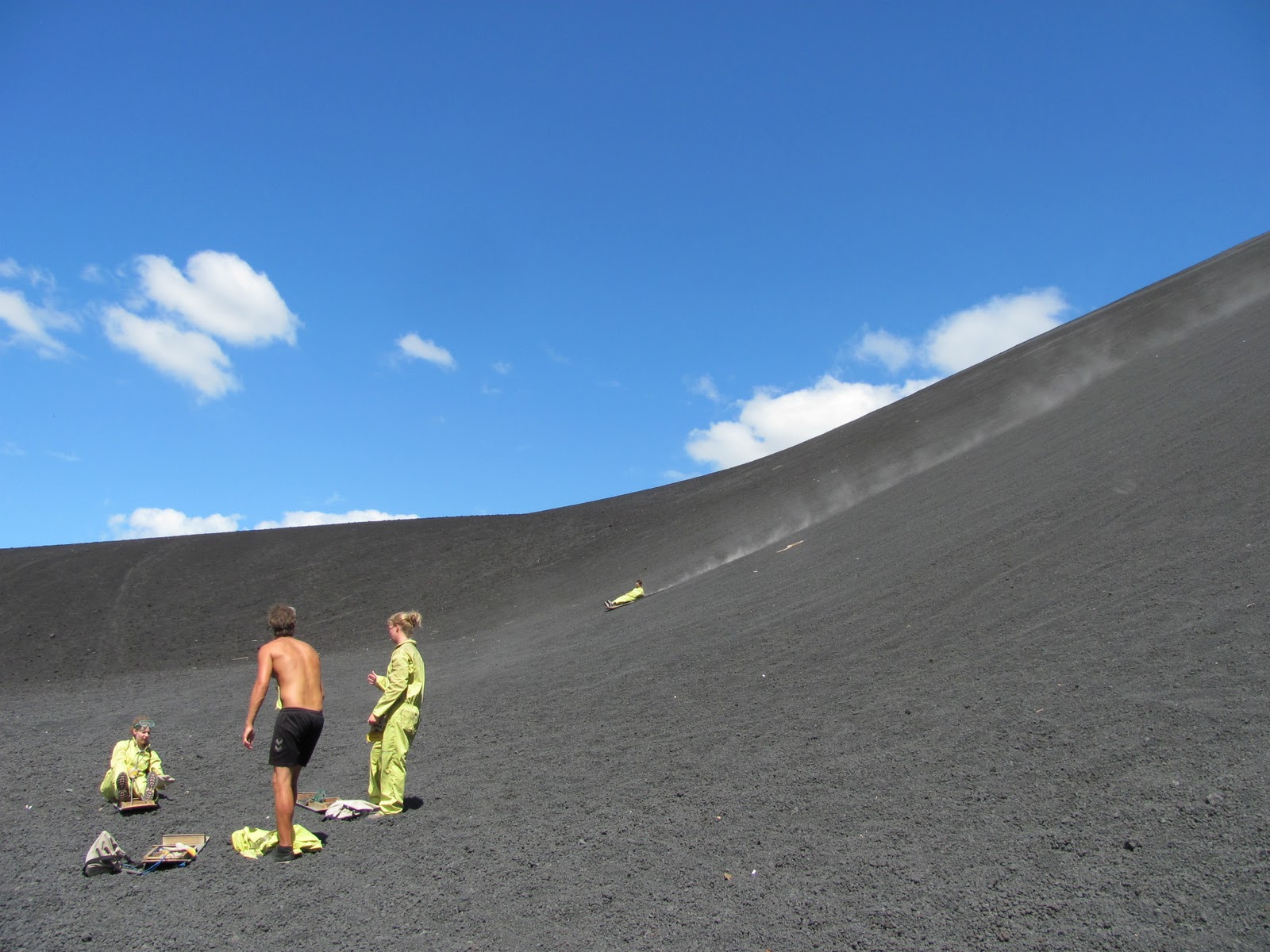
The bus ride from Managua took us past quite a few of these volcanoes, including the iconic Momotombo sitting on the shores of Lake Managua with its perfect cone. Once in Leòn, Lene and I quickly signed up for a volcano tour of the surrounding area. We used a compnay called Quetzatl trekkers, mostly because of their status as a non-profit and their pledge to donate proceeds to helping street kids in Nicaragua. We signed up for a two day trek, the first day of which found us at the top of Cerro Negro clutching wooden planks and getting ready to slide down the steep sides of the active volcano. The slopes consisted mostly of small pieces of black volcanic rock and the crater belched out a constant supply of sulfurous smoke.

As we perched on the edge, decked out in protective suits, we debated who would go first. Though steep, the boards did not move nearly as fast as we thought since the ground was so abrasive. I tried to use the board standing up but it was much slower than sitting down and eventually everyone slid down the hill using their boards as sleds. Once at the bottom we snacked at the nearby ranger station before heading up a larger volcano called El Hoyo for the enormous sinkhole that had formed just below its crater. The hike was incredibly hot and steep and was only made worse by the sandy footing. Our packs were also abnormally heavy for such a short hike since each person needed to carry 17lbs of water due to the heat and the lack of any fresh water sources on the mountain. We were exhausted by the time we reached our campsite.

We camped just below the sinkhole and had a spectacular view of the countryside, including the crater lake we would be hiking to the next day. From our vantage point we could see nearly a quarter of the entire country. Once we'd dumped the heavy backs and gotten camp set up I walked up to the top of the volcano to look in the now vegetation filled crater. I also hiked over to a large sulfur vent which hit me with waves of hot, acrid air as the wind shifted. The vent itself was more of a cave and with the horrible stinking smoke pouring out of it appeared to be an entrance to the underworld.

We built a fire despite the heavy winds at the top before tucking into our sleeping bags. I never have had good luck with my rental gear and this time was no exception. Since it never rains during the dry season we were sleeping in the open, underneath a stunning array of stars. The only problem was the length of my sleeping bag which only came up to my shoulder. Though we were not high up, with the constant winds and the slight temperature drop it was enough to keep me waking up every hour or so shivering. Some good did come of this though as I was able to watch the quarter moon rise over the volcanic landscape.

The next day started early and we wanted to get to the crater lake before the temperature rose too much. It was a steep hike down and we were stiff from the long climb the day before but we made good time. Everyone had worked hard at drinking as much water as they could just so they wouldn't have to carry the weight anymore and our packs were much lighter as a result. At one point during our decent we heard two gunshots, one after the other. A few minutes later we came across two happy farmers on horseback, one of whom had a rifle slung on his back and was holding a dead iguana by the tail. I guess that was going to be their dinner for the night. They graciously let us snap a few photos before moving on.
We were sweaty and tired by the time we made it to the lake and had a great time cooling off in the blue water. We relaxed by the lake for nearly two hours before we had to pack up and hike another hour to catch our bus back to Leòn. We were both happy to be able to shower and change back at the hostel and decided the next place we went would be a little more relaxing. We'd been hearing rumors of an unspoiled fishing village called Jiquilillo and though it wasn't in our guidebook we decided to see if we could find it the next day.